What this guide covers
Compare parody scale, visual tone, performance requirements, and music-mixing focus. The goal is to help players make a useful choice or solve a real gameplay problem without requiring music-production experience.
A practical approach
- Compare the exact versions named on each page.
- Use the same number of performers.
- Separate visual preference from sound preference.
- Check device performance and touch behavior.
- Choose the version that fits your preferred complexity.
What to check before continuing
Where to go next
Use the related games and guides below to continue with a more specific version, device, or mixing goal.
Frequently asked questions
Does this advice work in every music-mixing game?
The core listening and layering method is widely applicable, while exact buttons and special modes can differ by game.
Do I need headphones?
They are optional, but headphones make quiet effects, bass parts, and stereo details easier to separate.
Should I fill every character slot?
No. A smaller arrangement often sounds clearer because every loop has more room.
Can I use these steps on mobile?
Yes. Use touch controls and landscape orientation when the game board needs additional horizontal space.
Scale or a more focused atmosphere?
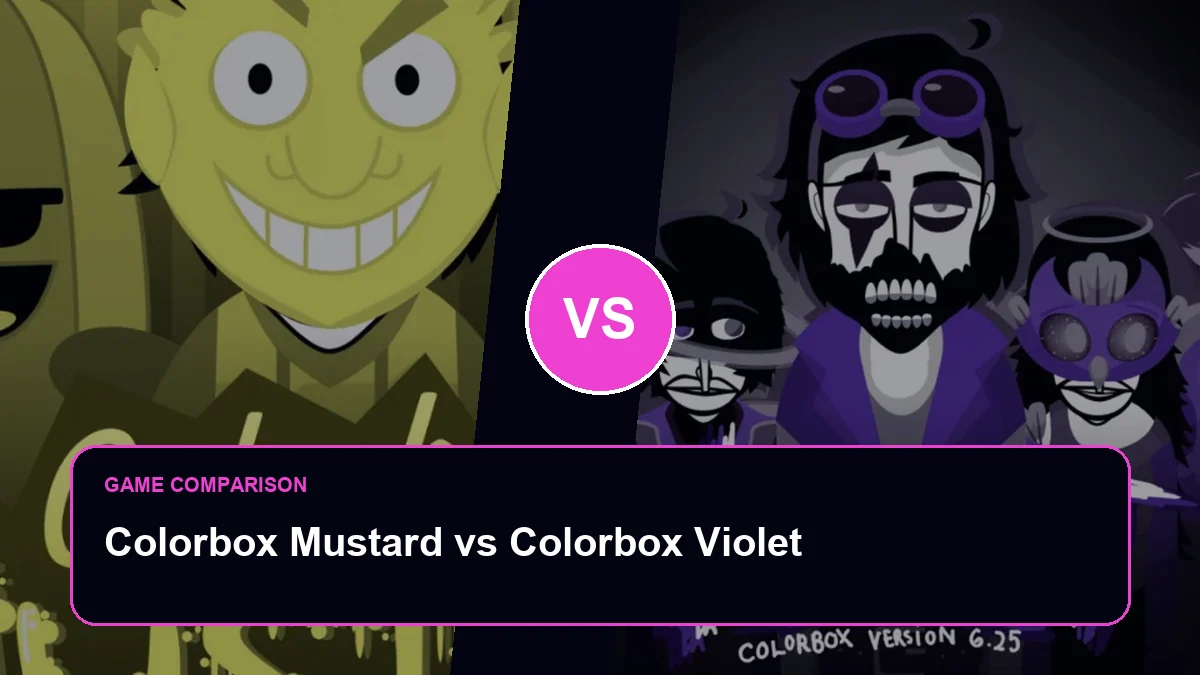
Colorbox Mustard emphasizes a broad parody-led experience with a larger sense of discovery, while Violet — Colorbox is easier to approach as a more focused purple-toned entry with its own cast and atmosphere. Start with Mustard if humorous presentation, secrets, and a busier set of possibilities matter most. Start with Violet when you want the theme to be immediately legible and would rather learn a narrower palette before exploring a larger project.
Compare them without letting roster size win
Use no more than five active performers in either game. Build a pulse, a low supporting part, one melodic idea, one voice, and one optional effect. Count how many selections you need before each role becomes clear. A large roster is useful only when its additional choices create distinct results; if several candidates perform nearly the same function, the apparent scale increases browsing time more than musical range.
Then test the interface at the device size you actually use. Check whether character controls remain readable, whether a mistaken selection can be reversed quickly, and whether animation competes with the sound. Mustard's broader presentation can reward longer exploration but may require more attention. Violet's stronger color identity can make a session feel coherent sooner, although a tighter theme may offer fewer surprises for someone who wants extended discovery.
Decision scenarios
A visitor with ten minutes and no prior Colorbox experience will usually get a clearer introduction from Violet because its theme is easier to grasp before exploring optional detail. Someone returning for a longer session may prefer Mustard because parody, secrets, and roster breadth create more reasons to keep looking. On mobile, give extra weight to control spacing and the number of visible choices; on desktop, the larger presentation has more room to communicate its variety. This comparison does not count characters or claim that one build contains every possible version. It evaluates the practical choice presented by these local game pages: focused atmosphere versus broader discovery. Revisit the decision after creating one sparse mix in each, because browsing options alone favors scale without proving musical usefulness.
Our conclusion
Mustard suits players who enjoy parody, abundance, and looking for optional details. Violet suits players who prioritize a consistent visual mood and a faster route to a coherent mix. Do not treat the bigger project as automatically better: choose Mustard for breadth and Violet for focus, then use the five-character test to confirm which sound palette you would actually revisit.
Final review note
For repeat visits, Mustard has the advantage when secrets, parody references, and a broader set of discoveries remain interesting after the first mix. Violet has the advantage when a consistent atmosphere helps you reach a coherent result quickly. Neither benefit is universal: breadth can become browsing overhead, while focus can become limiting. The better choice is the one whose tradeoff matches the length and device of your actual session.