What this guide covers
Compare two retro approaches through visual style, sound density, and roster readability. The goal is to help players make a useful choice or solve a real gameplay problem without requiring music-production experience.
A practical approach
- Compare the exact versions named on each page.
- Use the same number of performers.
- Separate visual preference from sound preference.
- Check device performance and touch behavior.
- Choose the version that fits your preferred complexity.
What to check before continuing
Where to go next
Use the related games and guides below to continue with a more specific version, device, or mixing goal.
Frequently asked questions
Does this advice work in every music-mixing game?
The core listening and layering method is widely applicable, while exact buttons and special modes can differ by game.
Do I need headphones?
They are optional, but headphones make quiet effects, bass parts, and stereo details easier to separate.
Should I fill every character slot?
No. A smaller arrangement often sounds clearer because every loop has more room.
Can I use these steps on mobile?
Yes. Use touch controls and landscape orientation when the game board needs additional horizontal space.
Two different meanings of retro
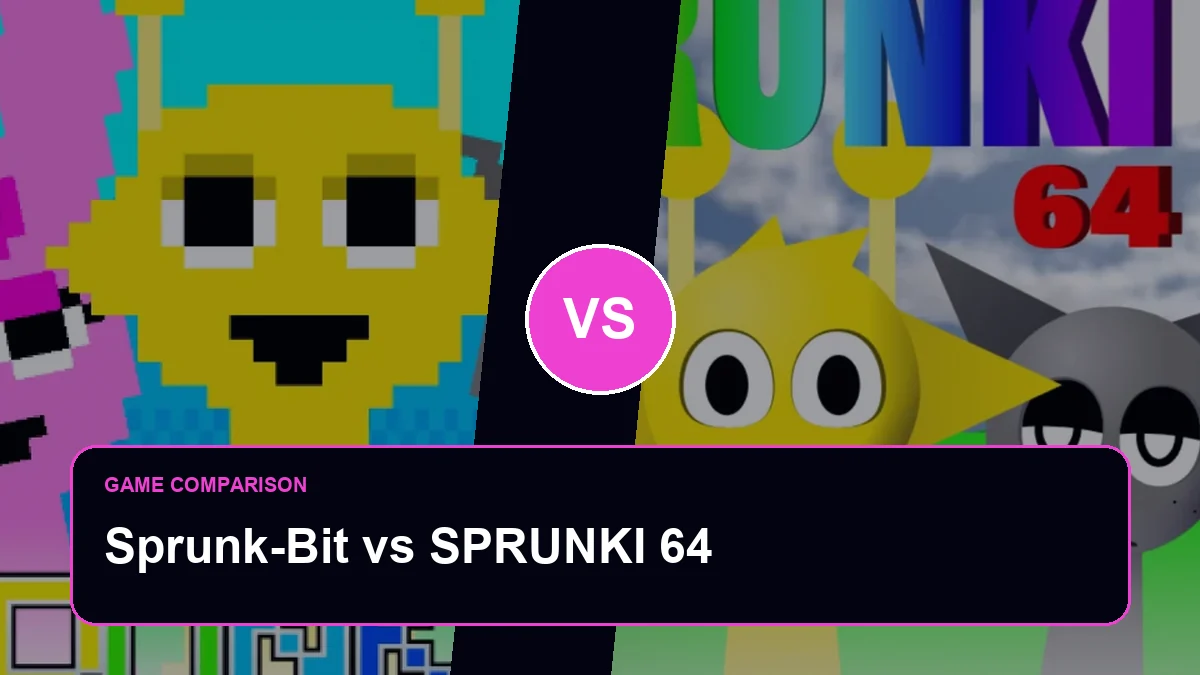
Sprunk-Bit uses an 8-bit visual and musical treatment as a compact identity, while SPRUNKI 64 leans toward a console-era presentation that reframes the familiar Sprunki idea through nostalgia. The distinction is useful: one can make retro limitations part of the sound palette, while the other can make the presentation and recognizable era the main attraction. Choose according to which layer you want to notice first.
Test sound density and visual readability
Build the same four-part recipe in both games and listen at ordinary laptop or phone volume. In Sprunk-Bit, check whether bright, compact tones leave enough space for bass and voice. In SPRUNKI 64, check whether the console-style presentation still makes active performers and controls easy to distinguish. Retro texture is effective when roles remain audible and visible; it becomes decoration when every part occupies the same busy range.
Then remove one performer from each mix. If the arrangement becomes clearer without losing its main idea, the roster was too dense. Small screens make this test especially relevant because nostalgic interfaces and stylized icons can be less readable than their modern equivalents. Headphones may reveal more detail, but neither game should require them merely to identify the pulse.
Decision scenarios
Choose Sprunk-Bit for a short session centered on compact electronic tones or when the sound palette should communicate the retro idea without much explanation. Choose SPRUNKI 64 when the appeal lies in seeing a familiar character mixer reframed through console-era presentation. Speakers are an important constraint: small phone hardware may hide low notes and make bright parts appear more dominant, so compare at the same volume and avoid judging bass from one device alone. This page does not use nostalgia as a quality score and does not assume that older-looking controls are simpler. It treats visual readability, role separation, and the ability to build a clear four-part loop as more useful evidence than the era suggested by either title.
Our conclusion
Sprunk-Bit is the better choice for players seeking a compact chiptune-like musical identity. SPRUNKI 64 fits those more interested in a console-era reinterpretation of Sprunki and its visual nostalgia. Try both when “retro” is the main search intent, because the shared label hides different priorities. Prefer the one whose theme continues to support the mix after the initial visual novelty fades.
Final review note
When both themes appeal equally, use readability as the tie-breaker. Test the active states at phone width, then at desktop width, and verify that the same performer can be identified without relying on color alone. Retro styling succeeds when it supports both nostalgia and control clarity. If one version requires constant visual searching, choose the other for longer mixing sessions even if its first impression is less dramatic.
If both remain readable, choose by the retro quality you intend to revisit: compact musical palette in Sprunk-Bit or console-era reinterpretation in SPRUNKI 64.